
Last updated: November 2, 2026
In 2020, building a Google Ads campaign took hours of keyword research, bid tweaks, and ad group surgery. Today, Google will build one for you in about ten minutes. That sounds like progress. For a lot of business owners, it’s the reason they’re quietly paying full price for an account nobody is really managing.
| Quick Summary | |
|---|---|
| The shift | Performance Max, Smart Bidding, and AI-driven broad match now handle most of the manual work PPC managers used to do. |
| The problem | Some agencies and junior reps use that automation as cover to do less, while fees stay the same or go up. |
| The real job now | Feed the AI clean data, protect your margins, and stop the algorithm from spending on junk. |
| The test | Four technical questions you can paste into an email to your current manager today. |
| Who this is for | Business owners paying an agency or freelancer and not sure what they’re getting for the fee. |
You’re not paying a PPC manager to pull levers anymore. You’re paying them to tell the machine what’s worth buying.
The “Set-and-Forget” Illusion
When I first wrote this post in 2020, I told you to ask about experience, budget control, and how many accounts a manager juggles. That advice still holds. But the job itself has changed so much that those questions no longer tell you whether someone is good at it.
Here’s how fast things moved:
- 2020: Manual and enhanced CPC bidding still common. Exact match meant (mostly) exact.
- 2021: Performance Max launches. Broad match modifier is retired.
- 2022: Smart Shopping and Local campaigns are folded into PMax. Expanded text ads stop accepting new ads.
- 2023–2024: Auto-applied recommendations expand. Broad match + Smart Bidding becomes Google’s default advice.
- 2025: PMax finally gets search terms reporting, channel reporting, and campaign-level negative keywords. AI Max for Search launches.
- 2026: Google starts moving Dynamic Search Ads into AI Max, and enhanced conversions for web and leads merge into a single setting.

Six years of Google Ads automation, from manual bids to AI Max.
The upside is real. Google’s AI can read thousands of signals per auction that no human could weigh by hand. The downside is that a campaign can now run with almost no human input. Running and performing are not the same thing.
A bad manager in 2020 had to at least touch the account to keep it alive. A bad manager in 2026 can launch PMax, turn on auto-apply, send you a monthly PDF, and let Google spend your money with zero oversight. The account won’t break. It’ll just slowly overpay for traffic you’d never have chosen.
Pro tip: Log into your account and open Recommendations → Auto-apply. If a long list of categories is switched on and nobody told you, that’s your first clue about how your account is being run.
The Industry’s Dirty Secret: Automation Made the Job Easier to Fake
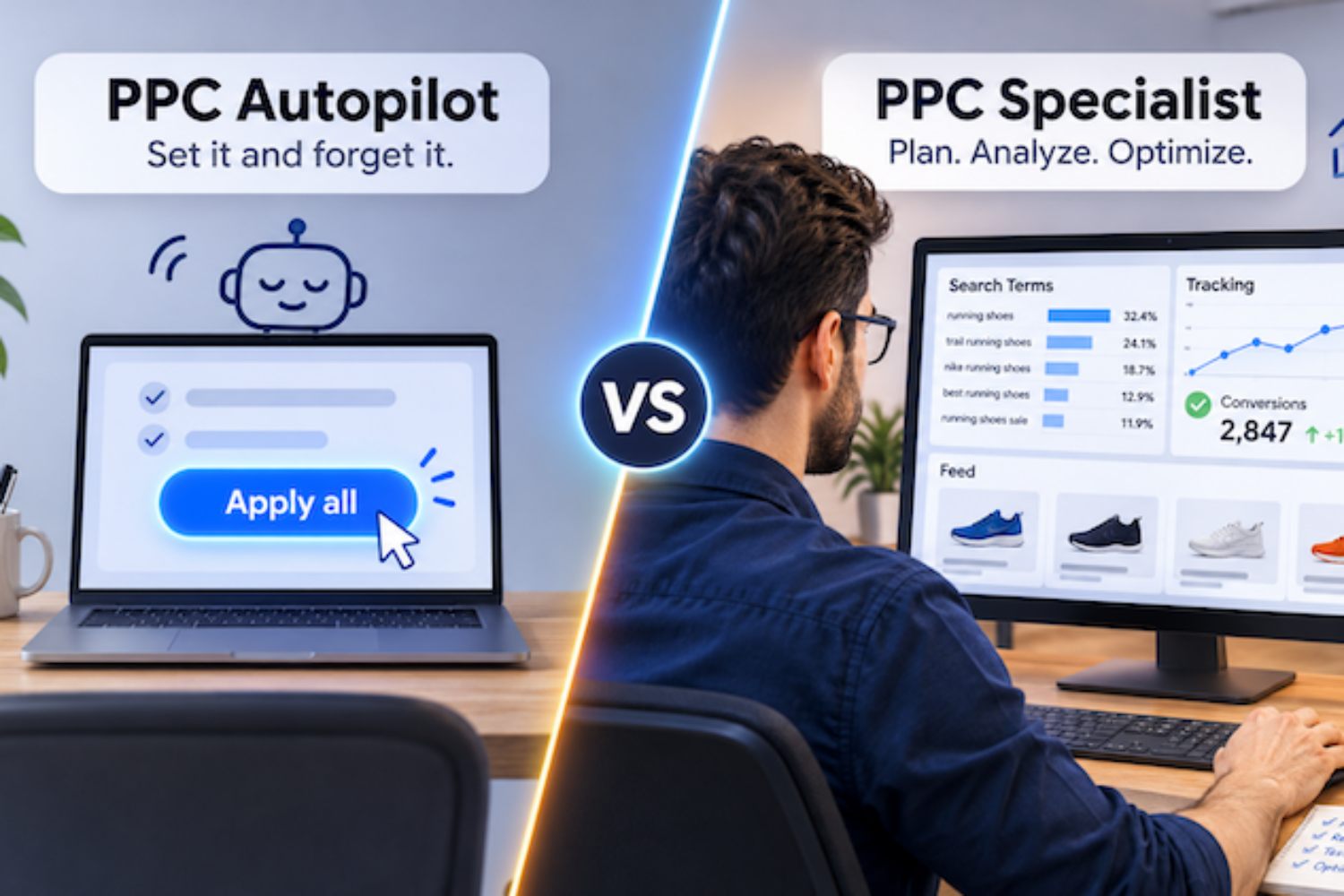
I’ll say the quiet part out loud. Many legacy agencies and junior account managers treat Google’s automation as a reason to do less work, not better work. The fee didn’t shrink when the workload did.
It’s not hard to see why. Google scores every account with an optimization score, and that score goes up when you accept Google’s recommendations. Agencies need to keep that score at 70% or higher to hold Google Partner status. So the easiest way to look “optimized” is to click Apply on whatever Google suggests.
The problem is who writes those suggestions. Raise the budget. Switch to broad match. Loosen your target ROAS. Add more keywords. Some are useful. Many are designed to help you spend more, and a manager who applies them all is letting the seller set the shopping list.
Google’s recommendations are a starting point for a conversation, not a strategy.
The “Apply” Manager vs. the Senior Specialist
| The “Apply” manager | The senior specialist | |
|---|---|---|
| Recommendations | Accepts most of them, often on auto-apply | Reviews each one against your margins and goals; dismisses plenty |
| What they optimize for | Platform metrics: clicks, impression share, platform ROAS | Profit, qualified leads, and closed revenue |
| Search terms | Rarely opened, especially in PMax | Reviewed weekly; negatives added aggressively |
| Conversion tracking | Whatever was set up at launch | Audited, de-duplicated, and tied to your CRM |
| Product feed | Raw site export | Optimized titles, fixed attributes, custom labels |
| Reporting | Monthly PDF with charts that always go up | Plain-English notes on what changed, why, and what’s next |
| Accounts per person | Often 30–50+ | Few enough to actually know your business |

Same tools, very different results.
Automation isn’t the enemy here. I use Performance Max, broad match, and Smart Bidding every week. The difference is that a qualified specialist guides the AI. An autopilot manager just watches it.
The 4 Questions That Expose an Autopilot Account
You don’t need to be a PPC expert to use these. Copy them into an email to your current manager and judge the answers. Specific, account-level answers are good. Generic jargon is a warning sign.
1. “How are we steering the AI away from vanity metrics and toward actual profit?”
Clicks don’t pay your rent.
Smart Bidding optimizes toward whatever you tell it is a conversion, at whatever value you assign it. If every lead or sale counts the same, the algorithm will happily chase the cheapest ones, even when those are your lowest-margin products or your worst-fit leads.
What a junior rep says: “Impression share is up 20%, traffic doubled, and ROAS is 6x.” It sounds great. But platform ROAS ignores margins, returns, and whether a lead ever became a customer.
What a qualified specialist says: They explain how real business value flows back into the account. For example:
- Value-based bidding (Maximize Conversion Value or Target ROAS) built on real order values or lead values, not a flat “1” for every conversion.
- Margin segmentation: splitting high-margin and low-margin products into separate campaigns or asset groups with different targets.
- Conversion value rules that weight better locations, devices, or audiences, plus the new customer acquisition goal when growth matters more than repeat buyers.
- Lead scoring for service businesses, so a $40,000 commercial job isn’t valued the same as a tire-kicker form fill.
Red flag answer: “Google handles that automatically.”
Why it matters: The AI is only as smart as the goal you give it. Feed it the wrong goal, and it gets very efficient at the wrong thing.

Smart Bidding chases whatever you tell it is valuable. Tell it the truth.
2. “Are you auditing our automated search terms, or letting Google choose our traffic blindly?”
Your search terms report is a receipt. Somebody should be reading it.
With broad match and Performance Max, Google decides which searches your ads show for. That’s fine when someone is watching. It’s expensive when no one is. (I covered this in depth in Exact Match vs. Broad Match + Smart Bidding.)
What a junior rep says: “PMax is a black box, so there’s not much we can see.” That was partly true in 2022. It isn’t now. Google has added PMax search terms reporting, channel performance reports, and campaign-level negative keywords (up to 10,000 per campaign).
What a qualified specialist says: They walk you through their routine:
- Reviewing Search and PMax search terms on a set schedule, weekly for most accounts.
- Building themed, shared negative keyword lists (jobs, DIY, free, competitors, wrong services, wrong locations).
- Using brand exclusions so PMax doesn’t take credit for people who were already searching your name.
- Checking placements and channel reports so Display and YouTube aren’t quietly eating budget.
- Promoting proven converting searches into their own exact or phrase match keywords.
Red flag answer: They can’t name a single negative keyword they added last month.
Why it matters: Your keyword list tells Google what you want. Your negative list tells Google what you’ll never pay for.

PMax search terms are visible now. Someone should be reading them.
3. “How are we tracking conversions in the age of AI and privacy restrictions?”
Bad data in, bad bids out.
This is the question that separates technicians from button-clickers. Smart Bidding learns from your conversion data. If that data is double-counted, incomplete, or measuring the wrong action, every automated bid is built on a bad foundation.
What a junior rep says: “The pixel is installed and conversions are firing.” They haven’t checked for duplicate form submissions, “conversions” that are really page views, or a 30% gap between Google Ads and your CRM.
What a qualified specialist says: They describe a layered setup:
- GA4 and Google Ads configured with clear primary and secondary conversion actions, so bidding only optimizes toward what matters.
- Enhanced conversions turned on, sending hashed first-party data (like email) to recover conversions that cookies miss.
- Consent Mode v2 set up correctly for privacy compliance, plus server-side tagging where it makes sense for data durability.
- Offline conversion imports from your CRM through Google’s Data Manager, so the AI learns from qualified leads and closed revenue, not just form fills.
- Regular audits for duplicate tags, broken thank-you pages, and call tracking that counts 10-second hang-ups.
Red flag answer: “What’s a primary conversion?” or a long pause.
Why it matters: If your tracking counts spam leads as wins, Google will find you more spam. Feed it closed deals, and it learns to find more buyers.

Closing the loop: the AI should learn from revenue, not form fills.
4. “Can you show me the health and custom label structure of our product feed?” (eCommerce)
In Shopping and PMax, the feed is the targeting.
There are no keywords in a Shopping campaign. Google reads your product titles, descriptions, categories, and attributes to decide which searches you match. A messy feed means mismatched traffic, disapproved products, and wasted spend.
What a junior rep says: “The feed syncs from the website automatically.” Translation: they uploaded the raw site export to Merchant Center and hoped for the best.
What a qualified specialist says: They treat the feed as the engine of the account:
- Titles rewritten for how people actually search (brand + product type + key attribute like size, color, or material).
- Attributes corrected and filled in: GTINs, Google product category, product type, color, size, gender, and so on.
- Merchant Center diagnostics checked regularly so disapprovals and warnings don’t silently shut off products.
- Custom labels (Google allows five) used to group products by margin, best sellers, seasonality, price band, or clearance, so budgets and targets can push the inventory you actually want to sell.
- Supplemental feeds or feed rules to fix issues without waiting on your web developer.
Red flag answer: “What are custom labels?”
Why it matters: Two stores can sell the identical product at the identical price. The one with the better feed shows up for better searches and pays less to get there.

In Shopping and PMax, your feed is your keyword list.
Pro tip: If you’re a lead-gen business, swap Question 4 for this: “How are we qualifying leads, and does Google know which ones turned into customers?” It gets at the same thing: whether the AI is learning from real business outcomes.
Copy-and-Paste Email to Your PPC Manager
Hi [Name],
I’d like to better understand how our Google Ads account is being managed. Could you answer these before our next call?
- How are we steering the AI away from vanity metrics and toward actual profit?
- How often are you reviewing our search terms (including Performance Max), and what negatives did you add last month?
- How are we tracking conversions? Are enhanced conversions and CRM/offline imports set up?
- Can you show me the health and custom label structure of our product feed? (eCommerce only)
- Which Google recommendations are on auto-apply, and which have you dismissed recently?
Thanks, [Your name]
Old Hiring Advice vs. 2026 Reality
Some of my 2020 advice still stands. Ask about budget safeguards. Ask about their biggest mistake. Be wary of anyone promising results in 48 hours. But most of the old checklist needs an update.
| 2020 advice | 2026 reality |
|---|---|
| Ask how many years of experience they have. | Ask what they’ve done with PMax, value-based bidding, and offline conversions in the last 12 months. |
| Ask how many accounts they manage. | Ask who actually works on your account day to day, and how many other clients that person has. |
| Ask how they prevent budget disasters. | Ask how they stop automation from spending on junk: negatives, brand exclusions, and bid targets. |
| A good manager tweaks bids and keywords often. | A good manager feeds the AI better data and signals, then leaves it room to learn. |
| Quality Score is the metric to watch. | Profit, cost per qualified lead, and closed revenue are the metrics to watch. |
| Exact match keeps you in control. | Negatives, conversion data, and the feed keep you in control. |
| Ask about their biggest mistake. | Still a great question. Add: “Which Google recommendation have you refused, and why?” |
| Results take time. | Still true. Expect a learning period after big changes, and real reads in 60–90 days. |
The Autopilot Red-Flag Checklist
If you check three or more of these, your account is probably running on autopilot.
- Reports focus on clicks, impressions, or impression share instead of leads, sales, or revenue.
- Your optimization score is near 100%, but profit hasn’t improved.
- Many auto-apply recommendation categories are switched on.
- Nobody can tell you what negative keywords were added last month.
- Performance Max is running with no brand exclusions or negative keywords.
- Every conversion is valued the same, regardless of product or lead quality.
- Google Ads conversions don’t come close to matching your CRM or sales numbers.
- Enhanced conversions and offline imports aren’t set up.
- Your product feed is the raw website export with no custom labels.
- The person who sold you the service has never touched your account.

Three or more checks? It’s time for an audit.
Frequently Asked Questions
How do I know if my PPC manager is just applying Google’s recommendations?
Open Recommendations in your Google Ads account and check the Auto-apply settings and the History tab. If most changes in your change history came from recommendations, and your manager can’t explain why each was accepted, they’re likely deferring to Google instead of managing your account.
Is Performance Max bad for my business?
No. Performance Max can work very well, especially for eCommerce with a strong product feed. It goes wrong when it runs without negative keywords, brand exclusions, accurate conversion tracking, or someone reviewing where the budget actually goes.
Should I turn off auto-apply recommendations?
For most accounts, yes, at least for anything that changes budgets, bidding, keywords, or match types. A skilled manager reviews each recommendation and applies only the ones that fit your goals. A few low-risk categories can stay on if your manager is watching them.
What is a good optimization score in Google Ads?
There isn’t one that matters on its own. Optimization score measures how many of Google’s suggestions you’ve applied or dismissed, not how profitable your account is. A well-run account can have a modest score, and a poorly run account can sit at 100%.
How many accounts should a PPC manager handle?
It depends on account size and complexity, but the real question is who does the daily work. If a senior person sells the deal and a junior rep juggling dozens of clients manages it, your account won’t get much attention. Ask for the name and workload of the person actually making changes.
What are enhanced conversions in Google Ads?
Enhanced conversions send hashed, first-party customer data, like an email address, to Google when someone converts. That helps Google match conversions it would otherwise miss because of cookie and privacy limits. It gives Smart Bidding more complete data to learn from.
How long does it take a new PPC manager to show results?
Expect a learning period of a week or two after major bidding or campaign changes, and a clearer read in 60 to 90 days. Fixing tracking and feed problems often improves results faster than any bid change. Anyone promising overnight results is guessing. For new accounts, see how to make your first PPC campaign a success.
What does a free PPC audit include?
Mine covers conversion tracking accuracy, search terms and wasted spend, Performance Max controls, bidding strategy and goals, recommendation history, and product feed health for eCommerce. You get a plain-English summary of what’s working, what’s leaking money, and what to fix first.
Final Recommendation: The Handoff vs. the Specialist
Here’s how the typical agency model works. A senior salesperson pitches you, talks strategy, and wins the contract. Then your account gets handed to a junior rep managing 40 other clients. That rep doesn’t have time to mine search terms, rebuild your tracking, or fix your feed. So they click “Apply,” send the monthly report, and move on to the next account.
That’s not how I work. When you hire me, the person you talk to is the person in your account. I’ve spent more than 14 years in paid search and managed over $30 million in ad spend, and I still review search terms, tracking, and feeds myself. I use Google’s AI aggressively. I just don’t let it run unsupervised with your money.
If you ask your manager these questions and get generic jargon or blank stares, your account is likely running on autopilot. Let’s look under the hood together.
Want a second set of eyes?
Get a free, transparent PPC audit directly from a senior specialist, not a sales rep. I’ll show you where your budget is going, what your tracking is missing, and what I’d fix first.
Or learn more about my Paid Search Management services.
What answer did you get when you asked your PPC manager one of these questions? Share it in the comments or on LinkedIn. I’ve heard some wild ones.

